
Concrete retaining walls in McAllen TX - a slope that stays put when it rains
Soil washing down into your yard, or an old wall starting to lean? We build concrete walls that hold the slope and drain the water.
- Licensed and insured.
- Free estimates at your property.
- We respond within 1 business day.
Do you need a retaining wall for the slope in your McAllen yard?
A concrete retaining wall in McAllen, TX, is a solid wall that holds back a slope of soil and the water that collects behind it, so the ground above stays put and the yard below stays usable.
Most calls start with ground that's moving, like dirt washing onto a patio after a storm, a drop-off at the back fence, or a low wall someone built years ago that's starting to tip. What moves the price is the wall's length and height, how easy it is to get our crew and the concrete to the spot, how much digging and drainage the slope needs, and how involved the design gets. The schedule turns on the footing, which has to cure before the wall goes on it, and on any city paperwork the job needs. Once I've seen the slope, you'll get your own number in a written estimate.
How can you tell a slope or an old wall needs work?
Dirt washing over the edge
If mulch and soil end up on your patio or walk after every heavy rain, the slope is steeper than the ground can hold by itself, or an old wall has gaps. Each storm takes a little more of the yard, so the wall you need later is usually bigger than the one you need now.
An old wall leaning out
A wall whose top is tipping forward, or that has a long crack running through it, is usually being pushed by water it can't get rid of or is sitting on ground that moved. Walls rarely lean back on their own, and when one gives way it can take a fence, a slab or your plants with it.
Wet ground at the base
Muddy soil or stains along the bottom of a wall days after a rain mean water is collecting behind it and finding its own way out, through cracks or under the footing. That water softens the ground the wall stands on, which is how a small lean turns into a big one.
How we build concrete retaining walls
Water behind a wall is what I worry about most, so we plan the drainage as part of the wall itself, before anyone digs. We dig down to firm ground and pack the base, so the footing, the wide strip of concrete the wall stands on, sits on soil that won't settle later. We set rebar, the steel bars that keep the concrete from pulling apart when the soil pushes, then pour the footing and keep it damp while it cures, because concrete that dries out too fast stays weak. Then we form and pour the wall, put clean drain rock behind it with a way out for the water, and backfill in layers instead of all at once. If the budget gets tight, I'll steer you to save on the face of the wall before the footing or the drain, since those are buried on day one and they're what decide whether the wall stays straight.
A wall usually changes the flat work around it, so we plan the two together. If the wall levels out a backyard for one of our concrete pool decks, or holds the pad for a workshop that needs concrete floor installation, we set the drainage so the water from behind the wall runs away from the new slab, not under it.
Poured concrete wall
This suits a taller wall, a long straight run or a spot where you want a clean face that matches your slab. Concrete is rigid and can't bend, so if the ground under it shifts it cracks, which is why the dig-out and the packed base matter so much on this kind.
Stacked block wall
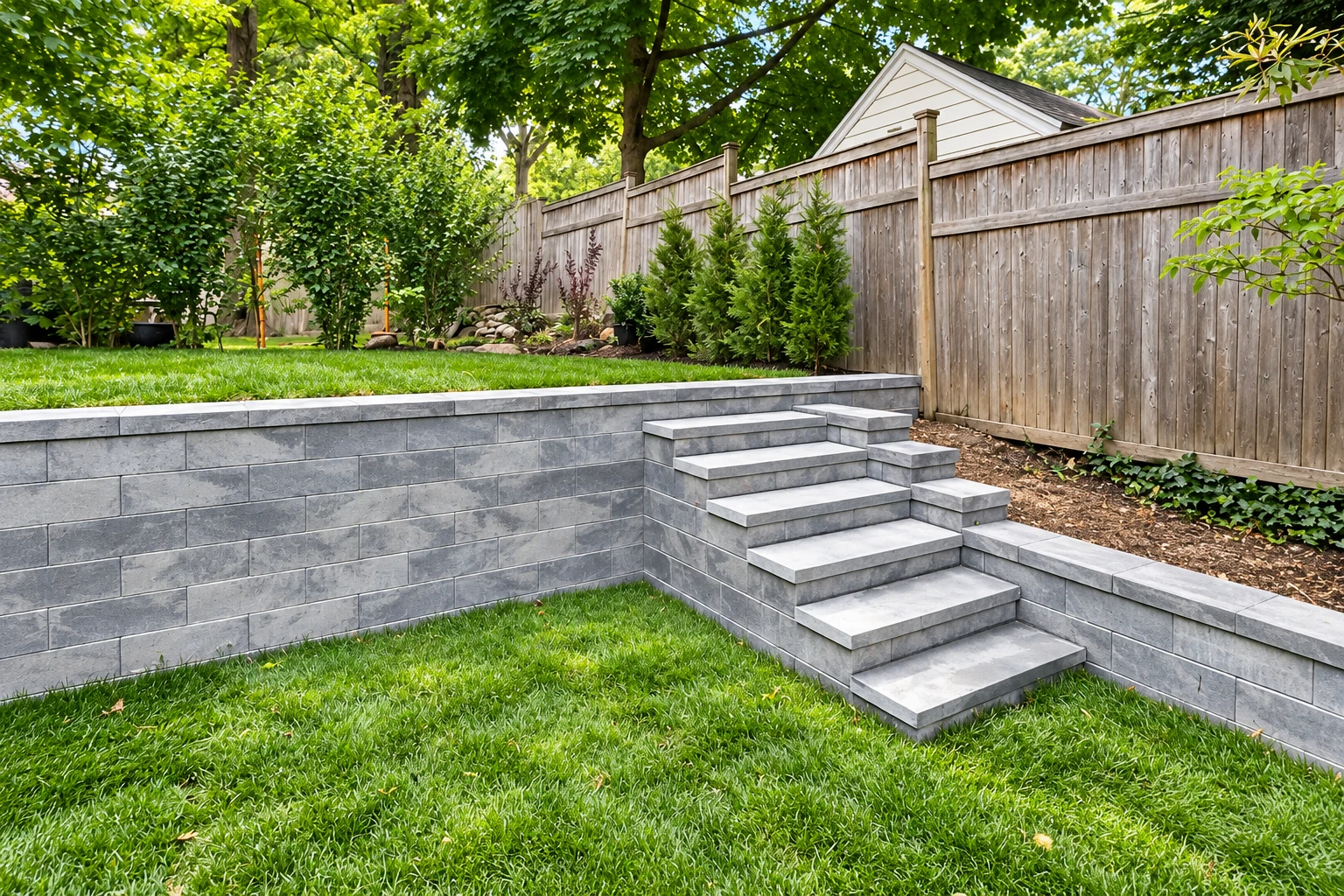
Unmortared block suits lower garden walls and curves, because the blocks can shift a little without the wall breaking. It still depends on a packed base and a way out for the water, so we don't cut corners there either.
Get a free, written estimate for your retaining wall
We'll get back to you within one business day to set a time, and I'll come out to measure the slope. The estimate is free, done on site and comes with no obligation.
- Based in
- McAllen, TX 78501
- Hours
- Mon–Sun: 7 AM–11 PM
What happens when you call about a retaining wall in McAllen?
From the first call to the last walk-around, here's what happens and who you'll be dealing with, so nothing about the job comes as a surprise.
Call us or send the form
Call (956) 331-0213 or send the form, and we'll set a time for me to come out. We're open seven days a week from 7 AM to 11 PM, so an evening call is fine.
I measure and ask questions
I walk the slope, take my own measurements and ask where the water goes when it rains, because that answer shapes the whole wall. You get the estimate in writing before anything is decided.
We line up any paperwork
If the job needs city paperwork or inspections, we help you line them up. We plan the pour around those dates so nobody is waiting on a footing that can't be covered yet.
We build, then walk it together
Our crew does the work with me on the job, from the dig-out to the last layer of backfill. When we're done, I walk the wall with you and show you where the water comes out.
Why McAllen homeowners call Craftsman McAllen Concrete Construction for walls
The owner sees every wall
I'm the one who comes out to look at your job, and I'm on site with our crew while it's built. The questions you ask on the first visit get answered by the same person who's watching your footing go in.
Building here since 2017
I learned concrete on a crew here in McAllen, pouring flatwork and foundations, and started this business in 2017. We're known for jobs with a catch, like an odd slope or a tight way into the backyard, and a retaining wall often comes with one.
A licensed and insured crew
We're licensed and insured, so you aren't taking on a crew with nothing behind it. Our promise is satisfaction guaranteed on every job, and if something's unclear before we dig, I'll tell you plainly instead of guessing.
On a retaining wall, the part that matters most is the drain you'll never see once the backfill is in. Tell us about your slope and I'll come take a look.
Retaining walls and the work around them in McAllen
In McAllen, the Building Permits and Inspections Department issues permits, and anyone planning to build, expand, change, move or tear down a building applies there first. Whether your wall needs a permit is something I check with the city rather than guess at. The city takes applications through its online permit portal and answers questions at 956-681-1300, and if you're not sure about yours, we'll check with the city office that covers your address and plan the pour around whatever it needs.
Much of the ground around McAllen is mapped as deep, well-drained soil on nearly flat land, so the walls we build here usually go where someone graded a yard, dug for a pool or raised a lot, not on steep hillsides. Fill dirt brought in for a lot doesn't always drain like the native soil, so we dig to see what's actually there before we size the footing. We're based in McAllen and work in McAllen and the cities around it, and we see the same flat ground and built-up lots on jobs in Pharr and Edinburg.
Questions about retaining walls in McAllen
How much does a concrete retaining wall cost in Texas?
Retaining wall construction in Texas usually costs about $30 to $39 per square foot. That's a statewide range, not a McAllen price, and a wall with a tricky design or a hard-to-reach backyard can land well away from it. Your own number comes in writing after I've measured.
Does a retaining wall over 4 feet tall need an engineer?
One footing guide advises an engineer's review for any wall over 4 feet of exposed height, which is just the part you see above the ground. McAllen's residential permit checklist also lists a professional engineer's design as one of its documents, and in Texas an engineer means someone licensed to practice engineering in the state. On a taller wall, I'll tell you up front if I think an engineer should look at it.
Why does drainage matter so much behind a retaining wall?
Water that collects behind a solid wall can push harder than the soil itself, so a wall with a good footing and no drainage can still fail. Clay-type soil is hard to drain once it's soaked, which is why wall designs nearly always call for gravel backfill that lets the water through. It's the first thing I ask about on a visit.
How long does it take to build a concrete retaining wall?
A retaining wall usually takes longer than the pour suggests, because the footing cures for several days and is kept damp before the wall goes on it. After the wall is up, the drain pipe and gravel backfill go in a layer at a time, so the size of your wall and any city inspections set the rest.
How do I know how big my retaining wall footing should be?
The footing's size depends on your soil, how high the water sits in the ground and any extra weight near the top of the wall, like a driveway, a shed or a pool deck. That's why I dig and look before I put a size on it, and why a taller wall can need an engineer's numbers.
What should I ask a contractor before building a retaining wall in McAllen?
Ask how local code requirements shape the engineering on your wall, which one block wall installation guide advises knowing before a project of any size. Then ask where the water behind the wall will go and how they'll build the base, because those two answers tell you more than the price does. Ask us the same things on the visit.
Related concrete work that often comes with walls
Concrete pool decks
A wall cut into a sloped backyard can make the level ground a pool needs, and the deck around it is poured to shed water away.
Concrete floor installation
If the wall holds up a pad for a shop, shed or storage room, we can pour the floor on that same packed ground while we're there.
Service areas for retaining walls around McAllen
Craftsman McAllen Concrete Construction is based in McAllen, Texas, and builds retaining walls in the cities around it. The 12 cities listed here each have their own page, from Mission to Weslaco, and they're not the only places we work.
Get your retaining wall measured and priced
Have the wall's rough length, how tall it'll stand above ground and a few photos of the slope handy, and the first visit gets right to the real questions.